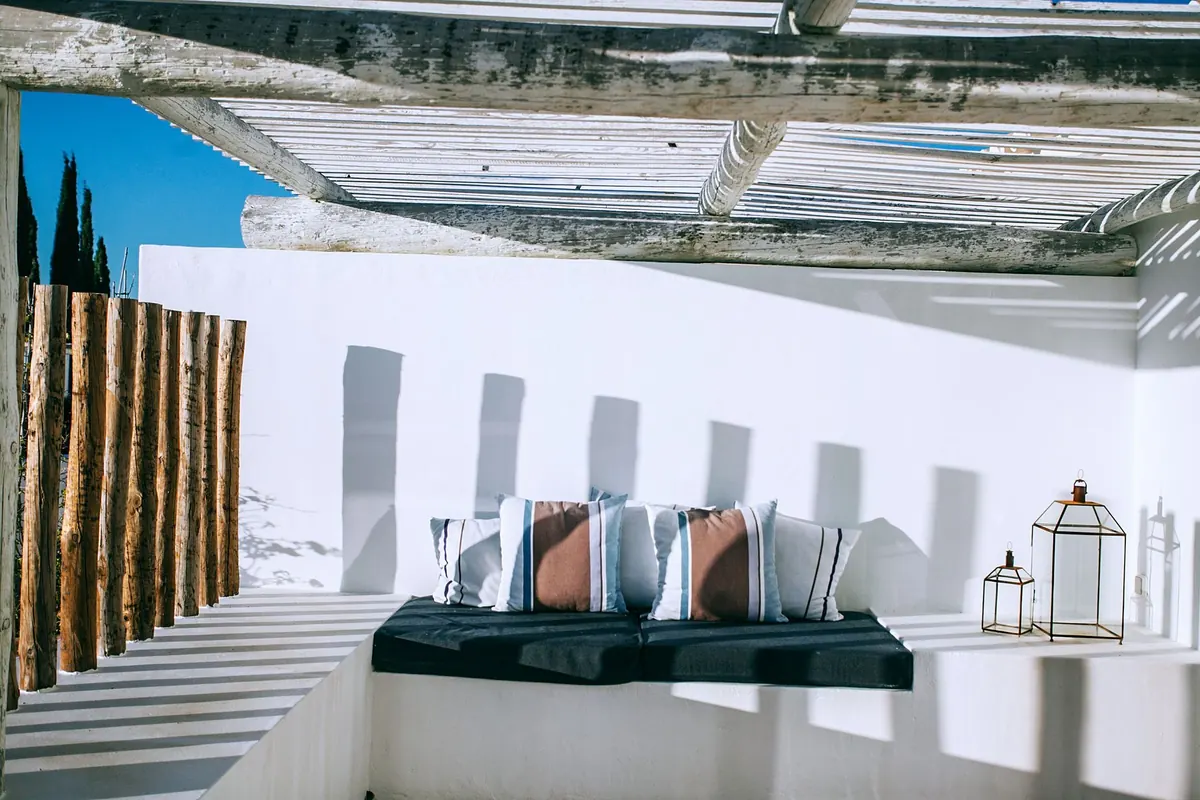
At two in the afternoon the town shuts its eyes. Shutters come down on the sunny side, a scooter fades up the hill, and the only sound on the street is someone rinsing a plate. Inside, the air stands still. Outside, on the porch, there is a small window of comfort that lasts from about one o'clock until the light turns gold — if you have set it up properly.
The porch is the best room in an Italian house in July, and it is almost never used as one. A chair, a table, a jug of water, and a decision about where the sun will land at four o'clock: that is the whole project. What follows is how to build that afternoon retreat with shade, moving air, and cold drinks, using what a porch already has.
Read the afternoon before you move a single chair
Spend a day doing nothing but watching your porch. Walk out at eleven, at half past one, and again at four. Put your palm flat on the floor tiles and the wall behind the seating. Note where the shade sits and where it will sit in two hours. Watch a ribbon tied to a post, or the smoke from a match, to see which way air actually moves — it is rarely the direction you assume.
Pay attention to surfaces, not just shadows. A west-facing wall absorbs heat all afternoon and radiates it back at you until nine in the evening, even after the sun has gone. A porch on the east or north side of a house tends to be usable by mid-afternoon. The floor matters too: terracotta and stone stay comparatively cool, timber decks and dark outdoor rugs do not.
This survey usually produces an uncomfortable conclusion: the furniture is in the wrong place. Move it. A porch does not need a fixed arrangement; it needs two or three chairs that can slide from the morning corner to the evening one.
Layer the shade instead of relying on one big umbrella
A single parasol deals with the sun directly overhead and fails completely at five o'clock, when light comes in low and horizontal. Think in layers instead, each one doing a different job.
- Overhead shade for the middle of the day: a fabric awning on an angled frame, a canvas sail tensioned with rope between two walls, or bamboo roller blinds hung from the beam.
- Vertical shade for the late afternoon: a cloth or blind dropped down the western edge, from the beam to about knee height, so the low sun never reaches the seats.
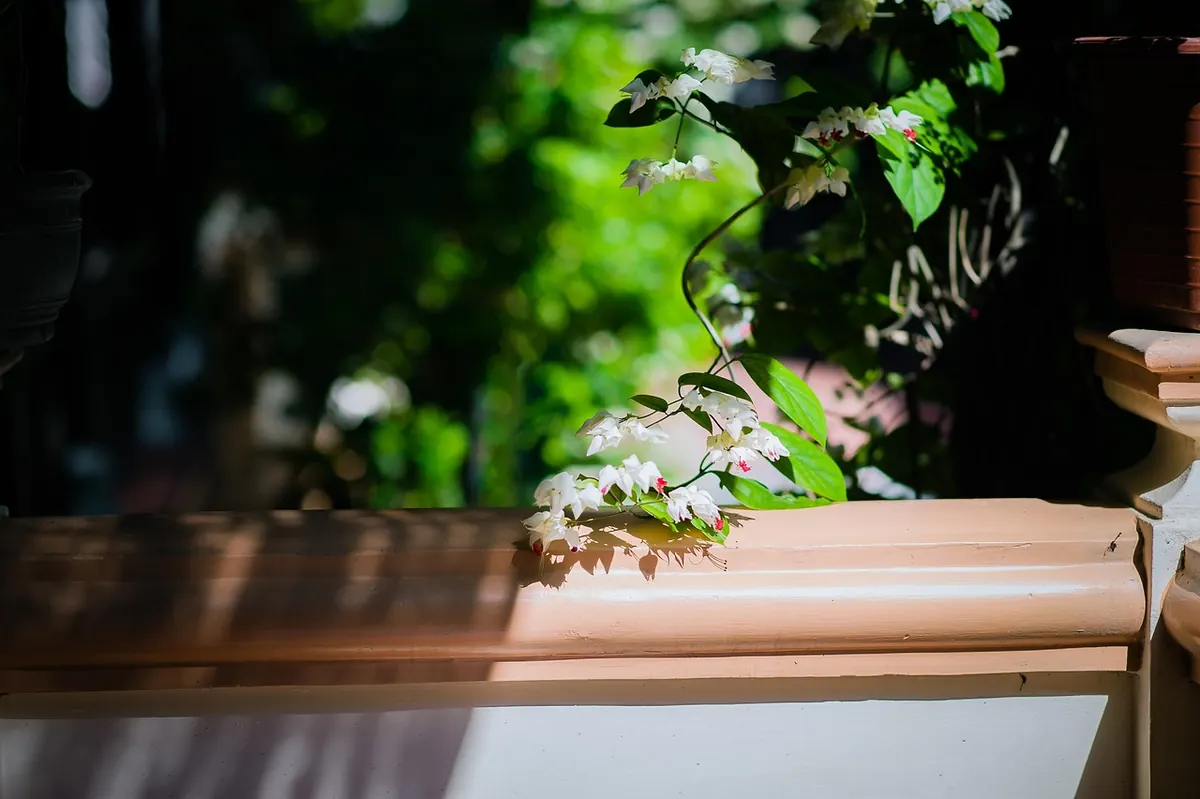
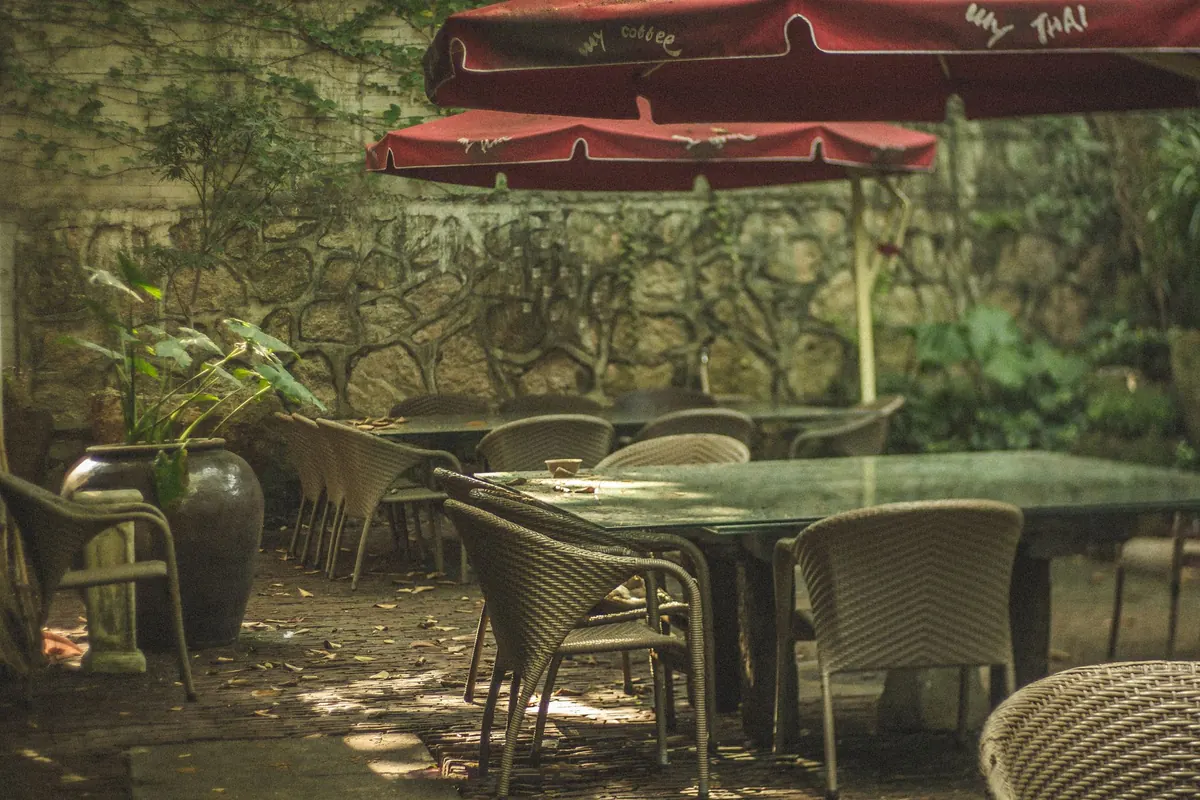
- Green shade for the long term: a potted fig, an oleander, or a grape vine trained on a wire. It takes two or three summers to work, and it cools the air around it as well as blocking light.
- Porous screens rather than solid panels: cane, reeds, and loose-weave fabric block sun but let air pass through. A solid sheet of dark nylon becomes a radiator.
Choose pale colours. A cream canvas reflects far more light than a charcoal one, and it makes the space feel cooler even when the thermometer disagrees. And keep the fabric loose enough to move; a blind that flaps gently tells you the air is alive.
Set up cross-ventilation as a system, not a habit
Air needs a way in and a way out. Two openings on opposite sides of the porch, ideally one low and one high, will do more than any fan. The warm air rises and leaves through the upper opening; cooler air is drawn in at floor level. Keep the path clear — the space behind the sofa and the clutter in front of the door are what kill it.
Open the interior door as well, so air can travel through the house and out the far side. This is why old apartments with two facades stay bearable in August. If you only have one opening, a fan set a metre back from it, aimed outward at window height, will pull hot air out of the room more effectively than one blowing directly at your face.
Timing matters more than equipment. Close everything by eight in the morning while the outside air is still cooler than the inside, then shut the sun-facing side completely. Around nine or ten at night, when the walls have finally given up their heat, open everything and let the porch and the rooms flush out. A cheap thermometer on the wall will tell you when to make each move; guessing is how people end up with a hot house and a fan running all day.
For direct relief, a ceiling fan or a standing fan aimed at the seating is enough — moving air on skin is what makes heat tolerable. Avoid pointing a fan at a sunbaked wall; you are only stirring warm air around.
Cool the body, not just the room
You cannot air-condition a porch, but you can lower the temperature of the person sitting on it. Cool water on the wrists, the back of the neck, and the ankles works quickly because the blood is close to the surface there. A basin of cold water for the feet under the chair is the single most effective thing on this list, and it costs nothing.
Keep a damp cotton towel over the back of a chair, and a spray bottle of water on the table. Wear loose linen or cotton in pale colours, and take a cool shower before the siesta rather than after it; sitting damp in a breeze is the oldest cooling system there is.
Drink before you feel thirsty, and keep water within arm's reach rather than in the kitchen. A short sensible note: heat affects people differently. Older guests, small children, and anyone taking medication that affects hydration or blood pressure should follow their own doctor's advice, and if someone becomes dizzy, headachy, or confused in the heat, move them to shade, cool them with wet cloths, and get proper help.
The drinks table, and what belongs on it
Put the drinks table in the shade it will still be in at five o'clock, not the shade it is in now. Keep it small and close to the seats, so nobody has to stand up.
Keeping cold drinks cold without a fridge on the porch
Wrap bottles and a jug in a wet terry towel and stand them in a shallow bowl of water; evaporation does the work and the cloth stays cool for an hour or more. Large blocks of ice melt far more slowly than small cubes, so freeze water in a bowl rather than a tray. Chill the glasses with cold water before pouring, and keep a second jug inside as backup instead of running back and forth.
Three things to make
Acqua e menta. A jug of cold water, a handful of mint crushed slightly against the side, lemon slices, and ice. Nothing else. It is what you actually want at three in the afternoon.
Caffè shakerato. Espresso, sugar while hot, then shaken hard with ice in a sealed shaker until the foam forms and the glass fogs. It takes a minute and it is better than any iced coffee made by pouring coffee over ice.
Limonata. Lemon juice, water, sugar to taste, mixed cold and served over a single large block of ice with the peel left in. Make it in the morning; it improves.
Keep the food simple and cool: cucumber, tomatoes with salt, bread, fruit cut just before eating. The aperitivo can wait until the light softens and the porch has been reopened.
Follow the rhythm of the day
The porch is not a fixed room; it is a sequence. Open it early and close it against the sun by mid-morning. Prepare the drinks and the foot basin before lunch, while you still have energy for it. Drop the western blind at half past one, eat lightly, and let the afternoon go quiet. Reopen at half past four, sweep the floor, water the pots, and stay out until the mosquitoes arrive.
This is the part visitors notice and locals never explain: the siesta is not laziness, it is scheduling. You move the heavy work to the morning and the evening, and you spend the worst hours in the coolest place you have.
The twenty-minute reset
Once the setup exists, keeping it working takes about twenty minutes a day. Do it in this order and it becomes automatic.
- Check where the sun line has moved and drop the western blind to match it.
- Open the two opposite openings, prop the interior door, and clear the air path.
- Fill the foot basin and hang the damp towel over the chair back.
- Move the drinks table into the new shade and re-wrap the bottle in fresh wet cloth.
- Set the fan where it helps the airflow rather than fighting it.
- Wipe the table, cut the fruit, put out the glasses.
- Sit down. Do not keep reorganising; the point of the setup is to be used.
By five the light comes in low and the porch becomes the best place in the house again. The shutters on the sunny side can stay closed until evening. That is not a compromise with the heat — it is the way the afternoon was meant to be spent.
Photo: ivi nnnnnn / Pexels